
Chicago Sexual Abuse Lawyers
Sexual abuse has changed the way you see people, institutions, and the places that were supposed to be safe. It took something from you that cannot be replaced. What happened to you does not define you. You are a survivor. You deserve to be heard, taken seriously, and told the truth about your legal options.
Our sexual abuse lawyers at Goldberg & Goldberg can help you break the silence. We’ll expose the truth and pursue accountability against the people and institutions that allowed abuse to happen or continue.
We represent survivors in civil sexual abuse cases involving powerful people, public figures, members of the clergy, trusted adults, schools, organizations, and institutions that failed to protect them. We listen with care, investigate with precision, and prepare every case as though it may need to be proven to a jury.
When you’re ready to talk to someone who will listen, our attorneys are here.
“You survived sexual abuse. When you come to us, you are trusting us with something deeply personal. Our job is to earn your trust. That starts by listening without judgment, telling you the truth, and treating you with the care you should have received from the people who failed you.”







A Trial-First Law Firm for Sexual Abuse Survivors
Sexual abuse cases require more than compassion. They require courage, discretion, careful investigation, and the willingness to take on powerful people and institutions when the evidence supports it.
At Goldberg & Goldberg, we do not treat sexual abuse claims like routine personal injury cases. We understand that your story is personal. We understand that trust has to be earned. We also understand that these cases can involve complicated facts, missing records, powerful defendants, institutional silence, and years of unanswered questions.
That is why we prepare every case from the beginning as though it may need to be proven to a jury.
We listen first. Then we investigate. We look at what happened, who had access, who knew about the danger, what policies existed, what warnings were ignored, and whether an institution protected itself instead of protecting you.
If the evidence supports a case, we move forward with the fearlessness, brutal honesty, and tender-loving care Goldberg & Goldberg is known for.
Call 312-626-8416. The call is confidential, and there is never a charge for your initial case evaluation.
We listen without judgment.
You decide what you are ready to share. We meet you with care, privacy, and respect.
We tell you the truth.
We will not make promises the evidence cannot support. We will explain what we see, what concerns us, and what options may be available.
We investigate what others ignored.
These cases often turn on records, complaints, policies, communications, and decisions that were hidden, dismissed, or never taken seriously.
We prepare for trial from day one.
Settlement is never the starting goal. The goal is to build the strongest case the evidence allows.
Civil Sexual Abuse Lawsuits Are Different From Criminal Cases
A criminal case is brought by the government. A civil sexual abuse lawsuit is brought by the survivor.
That difference matters.
A criminal prosecution may focus on whether the abuser can be punished under criminal law. A civil lawsuit asks a different set of questions:
- Who allowed this to happen?
- Who failed to act?
- Who had the power to protect you and did not?
- What harm did this cause, and what accountability is available through the civil justice system?
You may still have a civil claim even if no criminal charges were filed. You may still have a civil claim even if a criminal case did not lead to a conviction. You may still have options even if the abuse happened years ago.
The only way to know is to investigate the facts, the timing, the people involved, and the institutions that may have failed you.
Sexual Abuse Is Often an Institutional Failure
Sexual abuse is committed by an individual. But in many cases, the harm did not happen in isolation.
- Someone may have seen warning signs.
- Someone may have received a complaint.
- Someone may have ignored inappropriate conduct, poor supervision, boundary violations, grooming behavior, or prior allegations.
- Someone may have decided that protecting the institution mattered more than protecting the person being harmed.
That is where civil sexual abuse cases often begin.
Warning Signs Were Ignored
Many abuse cases involve conduct that should have raised concern before the abuse was fully discovered. Boundary violations, private communications, isolated access, favoritism, unexplained gifts, prior complaints, or changes in behavior may all become important during an investigation.
Complaints Were Dismissed or Mishandled
Some survivors reported abuse and were not believed. Others raised concerns and were met with silence, excuses, or internal processes designed to protect the organization. When complaints are ignored or minimized, abuse can continue.
Institutions Protected Themselves
Schools, churches, facilities, employers, and youth organizations may have reputations, donors, staff, insurers, or public images they want to protect. In serious abuse cases, we examine whether those interests were placed ahead of survivor safety.
Abusers Were Given Access
Sexual abuse often happens because someone was allowed access they should not have had. That may involve poor hiring, inadequate screening, weak supervision, unsafe policies, ignored complaints, or a failure to remove someone who posed a risk.
At Goldberg & Goldberg, we look beyond the individual abuser. We investigate the systems, decisions, and failures that allowed abuse to happen or continue.
“You may have been told to stay quiet. You may have been made to feel like no one would believe you. Our job is to take what happened seriously, uncover the facts, and determine who had the power to protect you but failed.”
Goldberg & Goldberg Has Taken on Powerful Abusers Before
Goldberg & Goldberg’s sexual abuse work includes high-profile litigation involving R. Kelly, one of the most widely reported sexual abuse cases in the country.
Long before the full scope of R. Kelly’s abuse became part of the national conversation, Ian Alexander represented Tiffany Hawkins in a civil lawsuit against him. That case became part of a larger public record about abuse, silence, power, and the courage it takes for survivors to come forward.
Goldberg & Goldberg does not include this history to sensationalize what happened. It matters because sexual abuse survivors deserve lawyers who understand how difficult these cases can be, how powerful the opposition may feel, and how important it is to investigate the truth without backing down.
Ian Alexander is widely recognized for his early legal involvement in bringing the sexual abuse allegations against R. Kelly to light.
Sexual Abuse Cases We Handle
Sexual abuse can happen anywhere someone is given trust, authority, or access to another person. It may involve a teacher, coach, clergy member, caregiver, medical provider, employer, counselor, staff member, volunteer, or another person who used that position to cause harm.
Goldberg & Goldberg represents survivors in serious civil sexual abuse claims involving many different settings, including schools, religious institutions, foster care placements, daycare facilities, youth organizations, camps, residential programs, medical settings, workplaces, and other institutions.
School Sexual Abuse
Students should be safe at school. When teachers abuse kids, or, coaches, administrators, staff members, volunteers, or other students commit sexual abuse at school, the school may be responsible if they failed to screen, supervise, investigate, report, or respond to warning signs.
Clergy Sexual Abuse
Clergy sexual abuse is a profound betrayal of spiritual trust. Civil claims may involve not only the clergy member who committed the abuse, but also the religious institution that enabled, concealed, transferred, or failed to prevent the abuse.
Foster Care Sexual Abuse
Children in foster care are already vulnerable. When sexual abuse occurs in a foster home, group home, residential facility, or placement setting, the investigation may involve caregivers, agencies, contractors, supervisors, and public or private entities responsible for child safety.
Daycare Sexual Abuse
Parents trust daycare providers to protect young children who may not be able to clearly explain what happened. Daycare sexual abuse cases require careful investigation into staffing, supervision, reporting, hiring, prior complaints, and facility safety practices.
Youth Sports Sexual Abuse
Coaches, trainers, volunteers, and athletic organizations often have significant influence over children and young athletes. Abuse in youth sports may involve grooming, private access, travel, ignored complaints, or organizations that failed to supervise adults in positions of trust.
Camp Sexual Abuse
Camps should provide safe environments for children. Sexual abuse in camp settings may involve counselors, staff, volunteers, other campers, poor supervision, unsafe sleeping arrangements, ignored warnings, or inadequate screening.
Troubled Teen Program Sexual Abuse
Residential treatment centers, wilderness programs, boarding schools, and troubled teen facilities may isolate young people from their families while giving staff significant control. Abuse in these settings can involve serious institutional failures.
Medical, Therapy, and Professional Sexual Abuse
Doctors, therapists, counselors, medical staff, and other professionals hold positions of trust. When that trust is exploited, civil claims may involve the individual provider, employer, facility, licensing issues, supervision failures, or prior complaints.
Workplace Sexual Abuse
Workplace sexual abuse can involve supervisors, coworkers, customers, contractors, or others connected to the job. Employers may be responsible when they ignore complaints, allow known risks to continue, or fail to protect employees.
Sex Trafficking and Exploitation
Sex trafficking claims may involve individuals, businesses, hotels, transportation companies, property owners, online platforms, or other entities that knowingly benefited from or failed to respond to signs of exploitation.
Institutional Sexual Abuse
Some abuse cases do not fit neatly into one category. If an institution gave someone access, ignored risk, failed to supervise, or protected itself instead of the person harmed, Goldberg & Goldberg can investigate whether an institutional sexual abuse claim exists.
Call 312-626-8416 to schedule your confidential case evaluation.
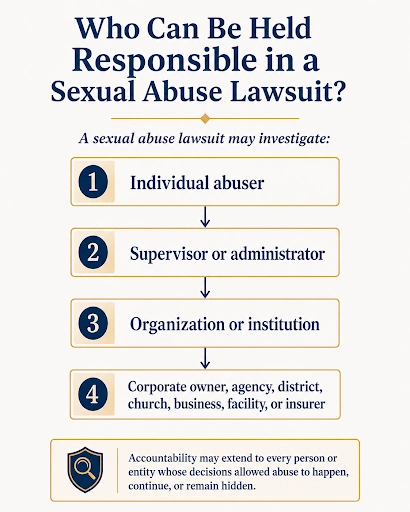
Who Can Be Held Responsible in a Sexual Abuse Lawsuit?
Accountability in a sexual abuse case may begin with the person who committed the abuse. Depending on the facts, it may also extend to the people, organizations, or institutions that had the power to prevent harm and failed to use it.
The Individual Abuser
The person who committed the abuse may be directly responsible for the harm caused. In some cases, a civil claim can be brought against the abuser personally.
Schools, Churches, and Youth Organizations
Institutions responsible for children, students, athletes, parishioners, or vulnerable people may be held accountable when their failures allowed abuse to happen or continue.
Foster Care Agencies, Contractors, and Residential Programs
Foster care and residential abuse cases may involve multiple layers of responsibility, including caregivers, private agencies, government contractors, supervisors, and facilities.
Employers and Businesses
Employers may be responsible when abuse occurs in connection with work, employment, services, or business operations, especially when warning signs were ignored or unsafe access was allowed.
Property Owners and Facilities
Some cases involve abuse that happened because a property owner, facility, hotel, residential program, or business failed to provide reasonable safety, supervision, or security.
Organizations That Covered Up or Ignored Abuse
When institutions conceal abuse, discourage reporting, transfer abusers, fail to warn others, or protect their reputation instead of people in their care, those decisions can become central to a civil lawsuit.
A civil sexual abuse lawsuit can seek accountability from more than the person who committed the abuse. Depending on the facts, a claim may also involve a school, church, foster care agency, daycare, youth organization, employer, property owner, medical provider, residential facility, or other institution that failed to protect you.
What Evidence Can Support a Sexual Abuse Case?
You do not need to have all the evidence before calling a lawyer. In many cases, survivors come to us with memories, concerns, fragments of records, or questions that have never been answered. Our job is to investigate.
Evidence in a sexual abuse case may include:
Prior Complaints or Reports
Earlier complaints, reports of boundary violations, disciplinary records, or concerns raised by others may show that an institution knew or should have known about the risk.
Personnel and Background Records
Hiring files, background checks, reference checks, employment records, volunteer files, disciplinary histories, or licensing records may reveal whether proper screening occurred.
Internal Communications
Emails, text messages, meeting notes, incident reports, or internal memos may show what people knew, when they knew it, and how they responded.
Policies and Training Materials
Written policies can show what an organization was supposed to do. Training records and safety procedures may help determine whether those rules were followed or ignored.
Medical, Therapy, or Counseling Records
Treatment records may help show the emotional, psychological, physical, and long-term impact of the abuse.
Witness Statements
Other survivors, employees, students, family members, coworkers, or people who observed warning signs may provide important information.
Criminal Case Materials
When a criminal investigation or prosecution occurred, police reports, charging documents, testimony, or other records may help support a civil claim.
- Listen
- Investigate
- Identify Failures
- Build the Evidence
- Prepare for Trial
- Pursue Accountability
How Goldberg & Goldberg Investigates Sexual Abuse Claims
Sexual abuse cases are built through patience, preparation, and precision. We do not rush to conclusions. We do not assume every institution is liable. We follow the evidence.
We Listen First
The first step is not interrogation. It is listening. We want to understand what happened, what you remember, what you were told, what you reported, and what questions still remain.
We Identify Who Had Power and Access
We look at who had access to you, who supervised that person, who controlled the environment, and who was responsible for safety.
We Look for Warning Signs
We investigate whether there were prior complaints, suspicious behavior, boundary violations, reports, rumors, or other signs that should have triggered action.
We Examine the Institution’s Response
When an organization learns about possible abuse, what it does next matters. We look at whether the institution investigated, reported, documented, acted, concealed, delayed, or looked away.
We Build the Evidence
Strong cases require strong records. We work to gather the documents, witness testimony, expert analysis, and other evidence needed to support the claim.
We Prepare for Trial
From the beginning, we ask the questions that matter: How will we prove this? What records do we need? Who needs to testify? What experts may be required? What will a jury need to understand?
Call 312-626-8416 to get started. Your consultation is free and confidential.
What Compensation May Be Available to Sexual Abuse Survivors?
As a sexual abuse survivor, you may be able to recover compensation for therapy and mental health care, medical expenses, emotional harm, lost income, future care, and in some cases punitive damages.
No amount of money can undo what happened to you, and a civil claim cannot give back what was taken. But it can help hold the responsible people or institutions accountable for the harm and help you access what you need to move forward.
Therapy, Counseling, and Mental Health Care
Survivors may need counseling, trauma therapy, psychiatric care, medication, or long-term mental health support. A civil claim may seek compensation for past and future treatment.
Medical Expenses
Some cases involve physical injuries, medical treatment, testing, medication, or other healthcare needs connected to the abuse.
Emotional Harm and Trauma
Sexual abuse can affect trust, relationships, sleep, work, school, faith, safety, and a survivor’s ability to move through the world. These harms matter in a civil case.
Lost Income or Reduced Earning Capacity
For some survivors, the effects of abuse interfere with education, career development, employment, or earning potential.
Future Care and Support
A serious case must account for what the survivor may need in the future, not only what has already happened.
Punitive Damages, When Available
In some cases, additional damages may be available to punish especially harmful conduct and deter similar wrongdoing.
You May Still Have a Case Even If the Abuse Happened Years Ago
Illinois law may allow some survivors to bring civil sexual abuse claims long after the abuse occurred, but deadlines are fact-specific. The rules may depend on the survivor’s age, the timing of the abuse, the type of defendant, and other legal issues. For example, Illinois law has specific rules governing the time to bring civil claims based on childhood sexual abuse.
Many survivors do not speak about sexual abuse right away. Some were children when it happened. Some were threatened, manipulated, shamed, or not believed. Some did not understand until years later that what happened to them was abuse.
You should not assume it is too late.
The safest step is to speak with a lawyer before deciding that you no longer have options.
Call 312-626-8416 for Goldberg & Goldberg.
Why Survivors Choose Goldberg & Goldberg
“Preparing for war does not mean living in battle mode. The strongest lawyers know why they fight, when to listen, and how to keep their humanity intact. When the real fight comes, purpose is more powerful than anger.”
Sexual abuse cases require lawyers who know how to fight. But they also require lawyers who know how to listen.
At Goldberg & Goldberg, trial preparation is not about being loud, reckless, or performative. It is about purpose. It is about knowing what has to be proven, what the evidence shows, what the other side will attack, and what your case will require if it has to be presented to a jury.
That matters in sexual abuse cases because survivors need both strength and care. You need lawyers who can challenge powerful people and institutions without losing sight of the person at the center of the case. You need fearlessness, brutal honesty, and tender-loving care.
That is the Goldberg & Goldberg difference. We prepare for the fight, but we never forget why we are fighting.
We Handle Serious Cases
Goldberg & Goldberg represents people whose lives have been changed by serious harm. Sexual abuse cases belong in the hands of lawyers who understand what is at stake.
We Tell the Truth
We will not tell you what you want to hear just to sign a case. We will tell you what the evidence shows, what challenges may exist, and what options you may have.
We Take on Powerful People and Institutions
These cases may involve schools, churches, businesses, agencies, facilities, employers, youth organizations, and people with influence. We are prepared for that fight.
We Prepare Every Case With Trial in Mind
Even when a case resolves without trial, preparation matters. The other side needs to know we are ready to prove the case if necessary.
Trust and confidence matter when choosing legal representation, and Goldberg & Goldberg delivers on both.
Frequently Asked Questions About Sexual Abuse Lawsuits
Do I have a sexual abuse case?
You may have a case if you were sexually abused and there is a legal basis to bring a civil claim against the person who abused you, an institution that failed to protect you, or both. Not every case requires proving that a separate organization was negligent. Some claims may be brought directly against the abuser. Others may also involve a school, church, employer, property owner, agency, facility, or other institution whose conduct allowed the abuse to happen or continue.
The only way to know is to review what happened, when it happened, who was involved, what evidence may exist, and which legal deadlines or exceptions may apply. At Goldberg & Goldberg, we will listen, investigate, and tell you the truth about whether the facts support a case.
Can I sue an institution for sexual abuse?
Yes, in some cases. Schools, churches, youth organizations, daycare facilities, foster care agencies, employers, businesses, property owners, and other institutions may be held responsible when their failures contributed to the abuse.
Do I need proof before calling a sexual abuse lawyer?
No. You do not need to have records, witnesses, or documents before contacting Goldberg & Goldberg. If we accept your case, we can investigate what evidence may exist and whether it supports a civil claim.
Can I file a civil lawsuit if there was no criminal conviction?
Possibly. A civil sexual abuse lawsuit is different from a criminal case. You may still have a civil claim even if no criminal charges were filed or no conviction occurred.
What if the person who abused me was never arrested?
You may still have a civil sexual abuse case even if the abuser was never arrested, charged, or convicted. A civil lawsuit is separate from the criminal process. Goldberg & Goldberg can review what happened, what evidence may exist, and whether the facts support a civil claim.
Will my sexual abuse case be confidential?
Your consultation with Goldberg & Goldberg is confidential. If a lawsuit is filed, there may be ways to protect your privacy depending on the facts and court rules. We can explain what privacy protections may be available.
What compensation is available in a sexual abuse lawsuit?
Compensation may include therapy, counseling, medical care, emotional harm, pain and suffering, lost income, future care, and other damages depending on the facts of the case.
What does it cost to speak with Goldberg & Goldberg?
There is no charge for a confidential case evaluation. If we accept your case, we handle sexual abuse claims on a contingency fee basis, which means you do not pay attorney fees unless we recover compensation for you.
Talk to Goldberg & Goldberg About What Happened
At Goldberg & Goldberg, your consultation is private, confidential, and free. We will listen to what happened, answer your questions, explain your legal options, and tell you the truth about what comes next.
Call Goldberg & Goldberg at 312-626-8416 to speak with a Chicago sexual abuse lawyer.
Get in Touch
1 Free Consultation
2 Brutal Honesty
3 Tender Loving Care
Fill out the contact form or call us at 312-626-8416 to schedule your free consultation.